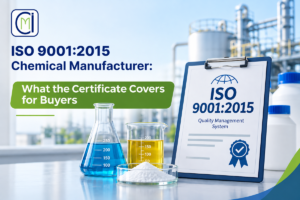
An ISO 9001 certified chemical manufacturer has had its quality management system audited by an independent certification body. The certificate covers that system, for the sites and activities named in its scope. It does not certify each product or batch, so you still need a certificate of analysis (COA) for every lot. This guide shows what the certificate covers, what it leaves out and how to verify it before you order.
What ISO 9001:2015 Certification Means
ISO 9001 is a quality management system standard, not a product standard. An accredited certification body checks that a manufacturer defines its processes, follows them, monitors its product and corrects nonconformities. IAF and ISO guidance says the expected outcome is an organisation that consistently provides products meeting customer and applicable statutory and regulatory requirements, and that certification does not imply a superior product. For a chemical buyer, that means process discipline, not a purity guarantee.
What the Certificate Covers
| Field | What it tells you |
|---|---|
| Certified organisation | The legal entity that was audited. The name should match your quotation and invoice. |
| Site or sites | The addresses audited. Check that the plant making your product is listed, not only an office. |
| Scope | The activities covered, such as manufacture and supply of named chemicals. Anything outside the wording is not covered. |
| Standard and edition | ISO 9001:2015 or ISO 9001:2026. |
| Certification body and accreditation mark | Who carried out the audit, and which accreditation body recognises them. |
| Issue and expiry dates | A certificate runs for three years, with surveillance audits in years 1 and 2. |
| Certificate number | The reference for looking the certificate up on the register. |
What the Certificate Does Not Cover
- Product specifications. ISO 9001 sets no limit for assay, iron, moisture or particle size. Those come from your agreed specification and the batch COA.
- Batch testing. Auditors assess the system. They do not test your lot.
- Zero defects. Certification does not guarantee defect-free product. It requires problems to be controlled and corrected.
- Other certificates and laws. Environmental (ISO 14001) and safety (ISO 45001) systems are separate certificates. REACH registration, GHS labelling and transport rules are legal requirements checked separately.
- Anything outside the scope. Other sites, and goods the manufacturer only trades, are covered only if the scope names them.
Want to check our certificate before you commit?
What an ISO 9001 Certified Chemical Manufacturer Has to Control
The standard has no chemical-specific rules, but several clauses translate directly into plant practice. Use this table to ask for evidence, not just a certificate. Clause numbers follow the 2015 edition.
| Clause | What the standard expects | Evidence to ask for |
|---|---|---|
| 8.4 External providers | Raw materials and outsourced steps come from approved, monitored suppliers. | Approved supplier list, incoming inspection records |
| 7.1.5 Measuring resources | Test instruments are calibrated or verified. | Calibration records for balances, pH meters and lab instruments |
| 8.5.1 Production control | A defined process with checks at set stages. | Batch manufacturing and in-process test records |
| 8.5.2 Traceability | Outputs are identified, and traceable where required. | Batch numbers on bags or drums that link to records and the COA |
| 8.5.4 Preservation | Product is protected during handling, storage and delivery. | Packing specification, storage conditions |
| 8.5.6 Control of changes | Changes to materials or process are reviewed before use. | Change records |
| 8.6 Release | Product is released only after planned checks pass. | COA signed against the specification |
| 8.7 Nonconforming outputs | Off-spec material is identified and held, reworked or rejected. | Nonconformity and hold records |
| 10.2 Corrective action | Failures and complaints are investigated for causes. | Corrective action reports |
ISO 9001:2015 and the ISO 9001:2026 Edition
ISO published ISO 9001:2026 on 16 September 2026, with a three-year transition that ends on 30 September 2029. ISO 9001:2015 certificates stay valid until then, so a current 2015 certificate is still acceptable. Certification bodies quote slightly different cut-off dates, so confirm the date with the issuer. When you check a certificate, note the edition, and ask a 2015 holder when it plans to move to the new one.
How to Verify an ISO 9001 Certificate
- Ask for the full certificate, not only a logo or badge.
- Note the certification body, certificate number and expiry date.
- Confirm the certification body is accredited by a recognised accreditation body, such as NABCB, JAS-ANZ, UKAS or ANAB.
- Search the certification body’s online register by company name or certificate number. The status should be active, not suspended or withdrawn.
- Match the scope and site to the product you are buying, and check the date of the last surveillance audit.
- If you cannot verify it online, write to the certification body directly.
Wording such as ‘ISO 9001 compliant’ or ‘ISO based’ is a self-declaration. Real certification comes from an independent audit by an accredited certification body.
What to Ask For Alongside the Certificate
The certificate covers the system. These documents cover the lot in front of you:
- A COA for each batch, with assay and key impurities against your specification
- The safety data sheet (SDS) for the product
- A written specification, including form, particle size and packing
- Batch numbers on bags or drums that match the COA
- Notice of any change in raw material source or process
Qualifying a new Indian source? Compare these chemical supplier red flags and the China plus one sourcing guide for the wider checklist.
Meghachem: ISO 9001:2015 Chemical Manufacturer in Ahmedabad
Meghachem Industries is an ISO 9001:2015 certified manufacturer of copper, tin, zinc and molybdenum chemicals in Vatva, Ahmedabad. Every batch is tested for consistency and performance, and each shipment goes out with a COA and SDS. See where each product is used in our guide to metal salts in industry.
Looking for an ISO 9001:2015 certified source of copper, tin, zinc or molybdenum chemicals?
FAQs
Does ISO 9001 certify the chemical product?
No. It certifies the manufacturer’s quality management system. Product quality is shown by the batch COA against your agreed specification.
How long is an ISO 9001 certificate valid?
Three years, with surveillance audits at the end of years 1 and 2 and a recertification audit in year 3.
How do I verify a chemical manufacturer's ISO 9001 certificate?
Get the full certificate, confirm the certification body is accredited, look up the certificate number on its register, and check that status, scope and site match your purchase.
Is ISO 9001:2015 still valid now that ISO 9001:2026 is out?
Yes. ISO published ISO 9001:2026 on 16 September 2026, and 2015 certificates stay valid until the transition ends on 30 September 2029. Confirm the exact date with the issuing certification body.
Does the certificate cover every product and site?
No. It covers only the activities and sites named in the scope. Check that the plant and product you are buying appear in the scope wording.