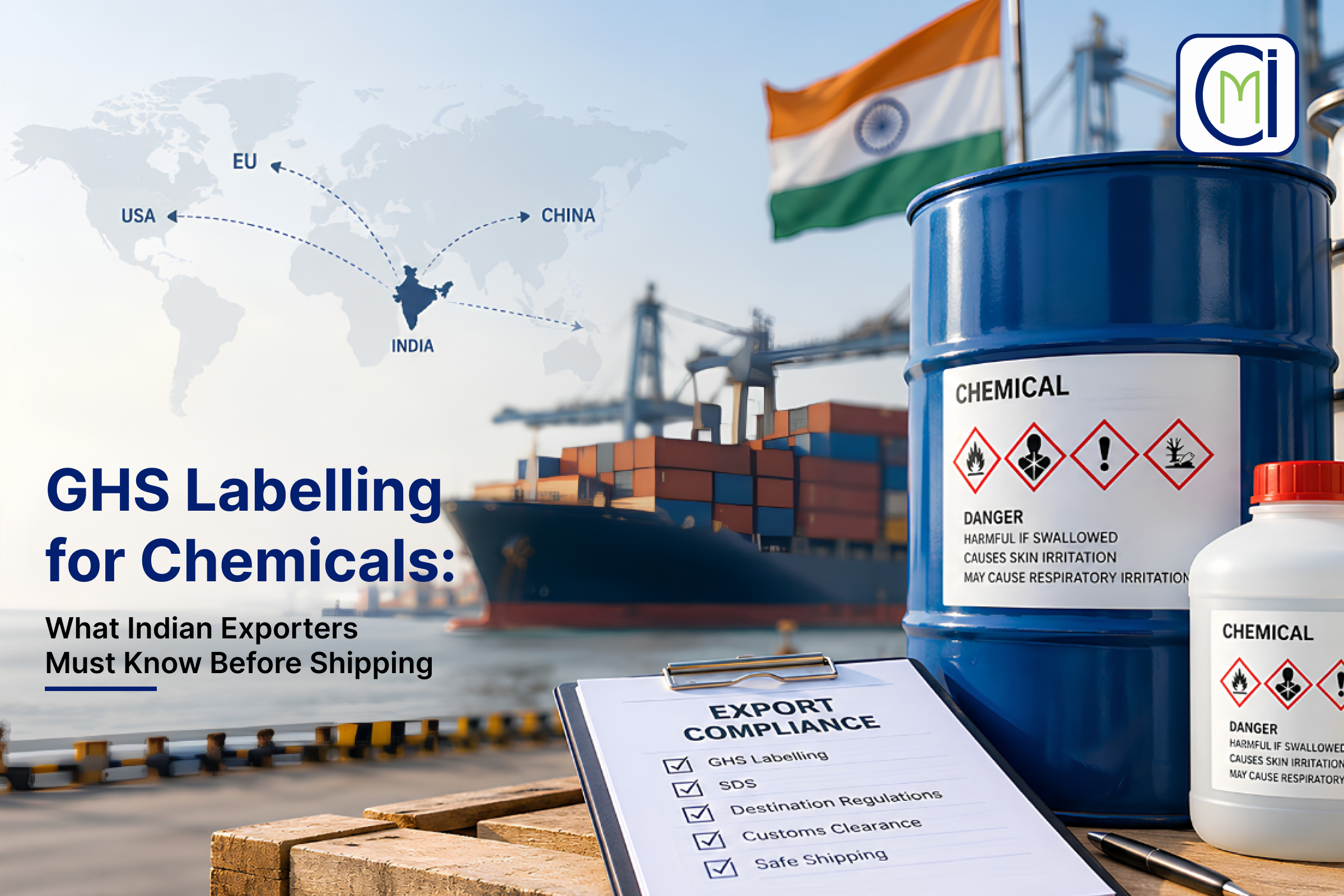
India hasn’t officially adopted the UN’s Globally Harmonized System of Classification and Labelling of Chemicals. That single fact catches a lot of Indian exporters off guard, because it means there’s no domestic “GHS law” to simply comply with and call it done. Every shipment has to be labelled to match the rules of the country it’s actually going to, not a generic Indian standard.
Get that wrong and the cost shows up at the port: held containers, demurrage charges, and a relabeling job under time pressure. Here’s what actually needs checking before a hazardous chemical shipment leaves India.
Does India Have Its Own GHS Regulation?
Not yet, formally. India’s domestic hazard rules still run on the Manufacture, Storage and Import of Hazardous Chemicals Rules, 1989, a nine-section framework written before GHS existed. A draft law, the Chemical (Management and Safety) Rules (ICMSR), proposes adopting the eighth revised edition of GHS with a full 16-section Safety Data Sheet format, but it remains a draft. India’s own IS 13252 standard offers a domestic reference point, but it isn’t the same as a fully adopted GHS implementation.
The practical effect: an Indian manufacturer can’t produce one “compliant” label and assume it satisfies every buyer. Compliance has to be built around the destination country’s actual regulation, whether that’s the EU’s CLP Regulation, US OSHA’s Hazard Communication Standard, or China’s GB 30000 series.
The Six Elements Every GHS Label Must Carry
Regardless of destination, a GHS-based label is built from the same six elements:
- Product identifier, the chemical name matching the SDS
- Signal word, either “Danger” for the more severe hazard categories or “Warning” for less severe ones, never both on the same label
- Hazard statements describing the specific risk
- Precautionary statements covering prevention, response, storage, and disposal
- Pictograms, the standardized hazard symbols
- Supplier identification, the manufacturer or exporter’s name and contact details
Missing any one of these, or mismatching the signal word to the hazard category, is one of the most common reasons a label fails an import inspection.
Why One GHS Label Doesn't Work for Every Market
The UN updates the Purple Book roughly every two years, and the latest edition, the eleventh, came out in September 2025. Individual countries take two to five years to fold a new revision into their own law, so most markets are still enforcing rules based on the seventh or eighth revision, not the newest one. Labelling to the newest UN text doesn’t guarantee compliance anywhere in particular.
Regional rules add their own layers on top. The EU’s CLP Regulation carries specific EU-language requirements. China’s GB 30000 series requires Mandarin-language labelling. US shipments fall under OSHA’s Hazard Communication Standard. A label built correctly for one of these typically needs real changes, not just a language swap, before it’s valid for another.
Exporting hazardous chemicals like zinc chloride or cuprous chloride and unsure which label format your buyer's country requires?
What a Failed Label Actually Costs
A label that doesn’t match the destination’s requirements gets caught at customs, not in your own warehouse. Once that happens, the container sits, typically racking up demurrage in the range of $75 to $150 a day, while a correct label and paperwork get sorted out. Relabeling an entire container after the fact commonly runs $800 to $2,500, on top of the delay itself and whatever it costs the buyer to explain a missed delivery date upstream.
That cost only shows up after the shipment has already left India, which is exactly why checking the label before dispatch is cheaper than fixing it after.
A Pre-Shipment Checklist for Indian Exporters
Before a hazardous chemical shipment leaves the factory:
- Confirm which regulation your buyer’s country actually enforces (CLP, HazCom, GB 30000, or another), not just “GHS” in general
- Confirm the required label language; some markets need the local language, not just English
- Check all six mandatory elements are present and the signal word matches the hazard category
- Cross-check that the label’s hazard classification matches the SDS exactly; mismatches between the two are a common inspection flag
- Confirm pictograms correspond only to hazards actually being declared, not a generic set
- Keep the Certificate of Analysis and MSDS ready alongside the shipment, not something sent after the buyer asks
FAQs
Not officially. India’s domestic rules still run on the 1989 Hazardous Chemicals Rules, and a draft law proposing GHS Revision 8 adoption hasn’t been finalized. Exporters need to follow the destination country’s specific regulation.
Product identifier, signal word, hazard statements, precautionary statements, pictograms, and supplier identification.
No. The EU, US, China, and other markets each implement GHS through their own regulation, with different language and formatting requirements. A label valid in one market can fail customs in another.
The container is typically held at customs, incurring demurrage charges while the label and documentation are corrected, plus relabeling costs on top of the delay.
Whichever revision the destination country actually enforces, which is usually a few editions behind the newest UN release, not the newest UN revision itself.