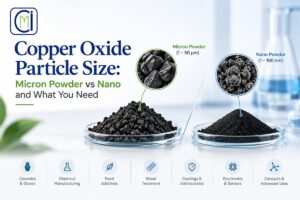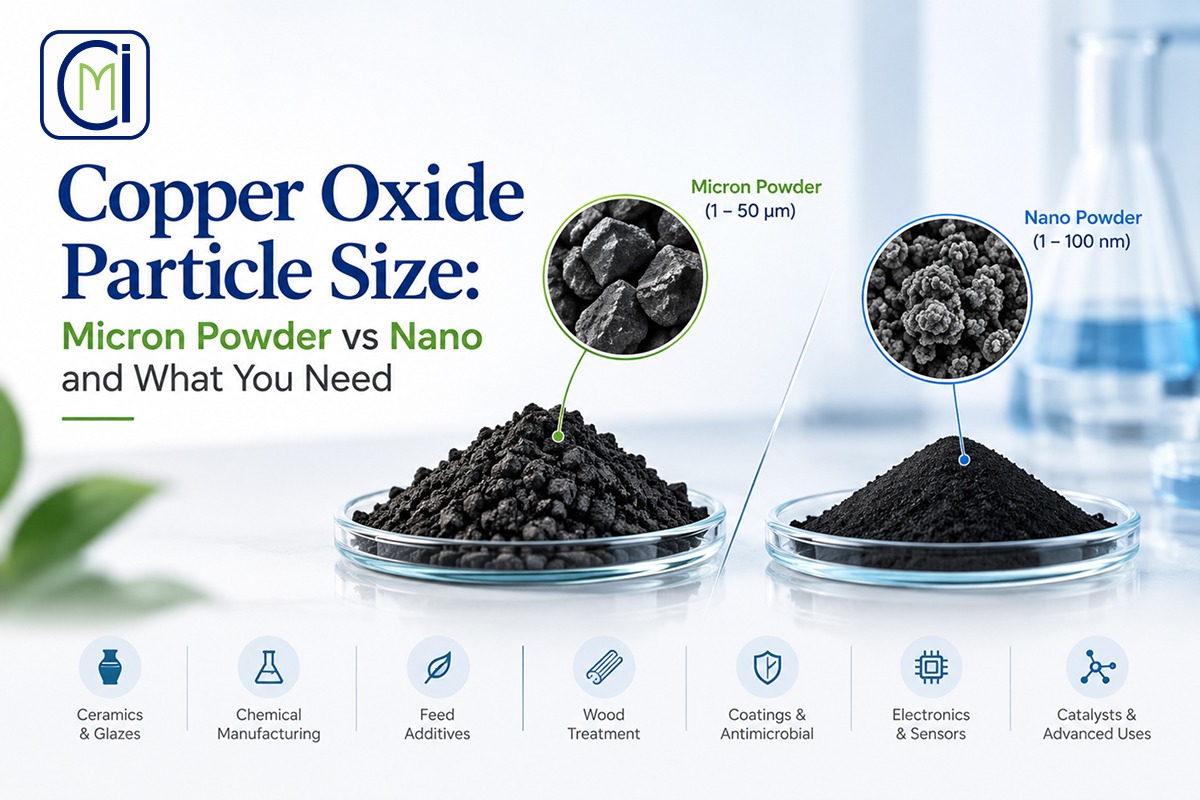
Copper oxide particle size controls how evenly the powder disperses, how fast it dissolves and how reactive it is. For most industrial uses, including ceramic colour, copper salts, feed and wood treatment, fine micron powder (about 1 to 50 µm) is usually the right choice. Nano grades (1 to 100 nm) earn their higher cost only where surface area is the point, such as sensors, thin films, antimicrobial coatings and some catalysts. Here is how the two compare, and what to write in your specification when you buy cupric oxide powder.
Micron, Submicron and Nano: What the Terms Mean
Micron powder is measured in micrometres (µm). Nano means 1 to 100 nm, the range used in the EU definition of a nanomaterial. Submicron powder sits between them at 0.1 to 1 µm. Smaller particles expose far more surface per gram, as the table shows for CuO.
| Class | Particle size | Surface area, m2/g* |
|---|---|---|
| Standard micron powder | 10 to 50 µm | 0.02 to 0.1 |
| Fine micron powder | 1 to 10 µm | 0.1 to 1 |
| Submicron powder | 0.1 to 1 µm | 1 to 10 |
| Nano powder | 10 to 100 nm | 10 to 95 |
*Calculated for dense, non-porous spheres with a CuO density of 6.315 g/cm3: surface area = 6 ÷ (density × diameter). Real BET values vary with shape, porosity and agglomeration. Even so, a 50 nm particle carries about 200 times the surface area per gram of a 10 µm particle.
Micron Powder vs Nano: The Trade-Offs
- Reactivity: nano’s extra surface speeds reactions and suits thin films, sensors and coatings. Micron powder reacts more slowly, which is fine for stable bulk processes.
- Dispersion: nano particles clump into agglomerates and usually need dispersants or milling. Micron powder weighs, flows and mixes easily. Specks in glazes often come from agglomerates, so sieve the slurry either way.
- Cost and supply: nano is made by specialist routes such as flame spray pyrolysis and costs far more per kilogram. Micron powder moves in tonne lots, in bags and bulk bags.
- Regulation: in the EU, nanoforms have had to be characterised in REACH registrations since 1 January 2020. The EU definition counts particles by number, with 50% or more between 1 and 100 nm. A volume-based D50 from laser diffraction does not settle that, so ask for number-based data if you ship into the EU.
Copper Oxide Particle Size by Use
| Use | Size that usually works | Why |
|---|---|---|
| Ceramic glazes and glass colour | Fine micron, sieved | Even dispersion matters more than ultrafine size |
| Copper salts such as cupric chloride | Fine micron | More surface area dissolves faster in acid |
| Feed and fertilizer | Micron | Conventional form; nano is still research |
| Wood preservatives | Micronized, as the formulator specifies | Reported sizes span 1 nm to 25 µm |
| Catalysts | Fine micron to nano | Activity follows accessible surface area |
| Electronics, sensors, antimicrobial coatings | Submicron to nano | Surface area and film uniformity drive performance |
Two cases deserve a closer look. In wood treatment, most micronized preservatives use basic copper carbonate dispersed in water, and size affects how deep the particles reach. In feed, a Harper Adams University thesis found that nano CuO raised liver copper in lambs and dairy cows more than conventional CuO. It estimated relative bioavailability at 0.23 to 0.81 against copper sulphate, versus about 0.15 for conventional oxide. The trials were short, so treat this as research and check feed rules in your market.
Not sure which particle size your process needs?
What to Put in Your Specification
“Fine powder” is not a specification. Ask for numbers, the method used, and the same method on every lot’s COA.
| Parameter | How it is measured | Why ask |
|---|---|---|
| D10, D50, D90 | Laser diffraction (volume-based) | Shows typical size and the coarse tail |
| Sieve residue or mesh | Test sieve (325 mesh is about 45 µm) | Simple pass or fail for glazes and mixes |
| Surface area | BET gas adsorption, m2/g | Predicts reactivity for catalysts and coatings |
| Primary particle size | SEM or TEM | Needed to back any nano or submicron claim |
| Purity and impurities | CuO %, copper %, chloride, iron, acid insoluble | Size does not replace purity |
Meghachem Copper Oxide at a Glance
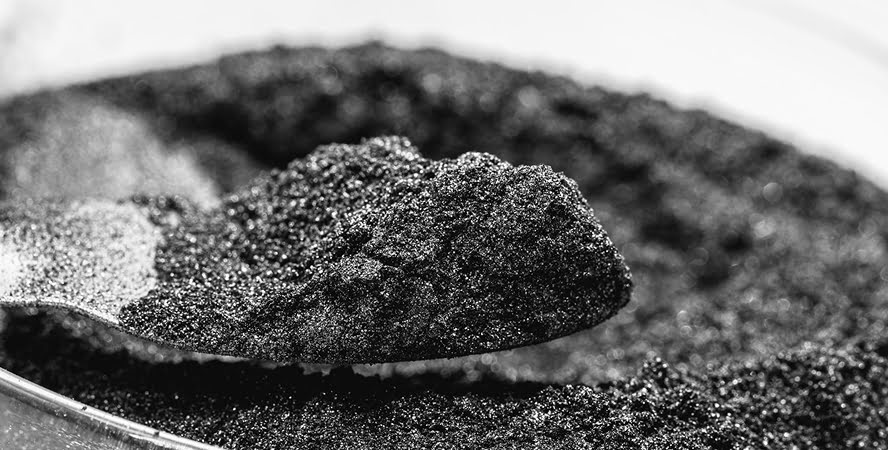
- Cupric oxide (CuO), fine black powder, CAS 1317-38-0
- CuO 97.00% min, copper 77.50% min, chloride not detected
- Acid insoluble 100 ppm max, iron 50 ppm max
- Lined HDPE bags of 25 and 50 kg, bulk bags up to 1 MT
- Custom particle size, purity and packing on request, with a certificate of analysis on every shipment
- Part of the copper chemicals range, exported to 25+ countries
Handling and Transport
Finer powder is dustier, so use dust control, gloves and respiratory protection, keep it dry, and follow the safety data sheet. Nano grades may need extra precautions, so read the supplier’s SDS. Many SDSs list copper oxide as UN 3077 (Class 9, marine pollutant), but classifications vary by supplier, so confirm yours against the SDS and the current IMDG Code.
Meghachem manufactures cupric oxide in Ahmedabad, ISO-certified and export-ready.
FAQs
What particle size is copper oxide?
It ranges from nano (1 to 100 nm) to coarse micron powder of tens of micrometres. The right size depends on the use, so specify D50 and D90 rather than just “fine”.
Is nano copper oxide better than micron powder?
Not by default. Nano gives far more surface area per gram, which helps sensors, coatings and some catalysts, but it costs more, clumps and faces extra regulation. Most ceramic, salt and wood-treatment uses work with fine micron powder.
How is copper oxide particle size measured?
Laser diffraction gives D10, D50 and D90, BET gives surface area in m2/g, and SEM or TEM shows primary particle size. Ask for the method on the COA.
Does finer copper oxide dissolve faster?
Yes. CuO does not dissolve in water but dissolves in mineral acids, and finer powder dissolves faster because more surface is exposed.
Can I order a specific copper oxide particle size from Meghachem?
Meghachem’s cupric oxide is a fine black powder, and custom particle size is available on request. Share your D50, D90 or mesh target and any surface area need, and confirm feasibility before ordering.