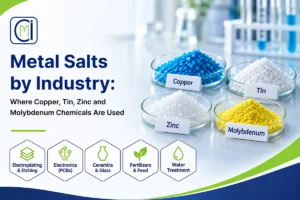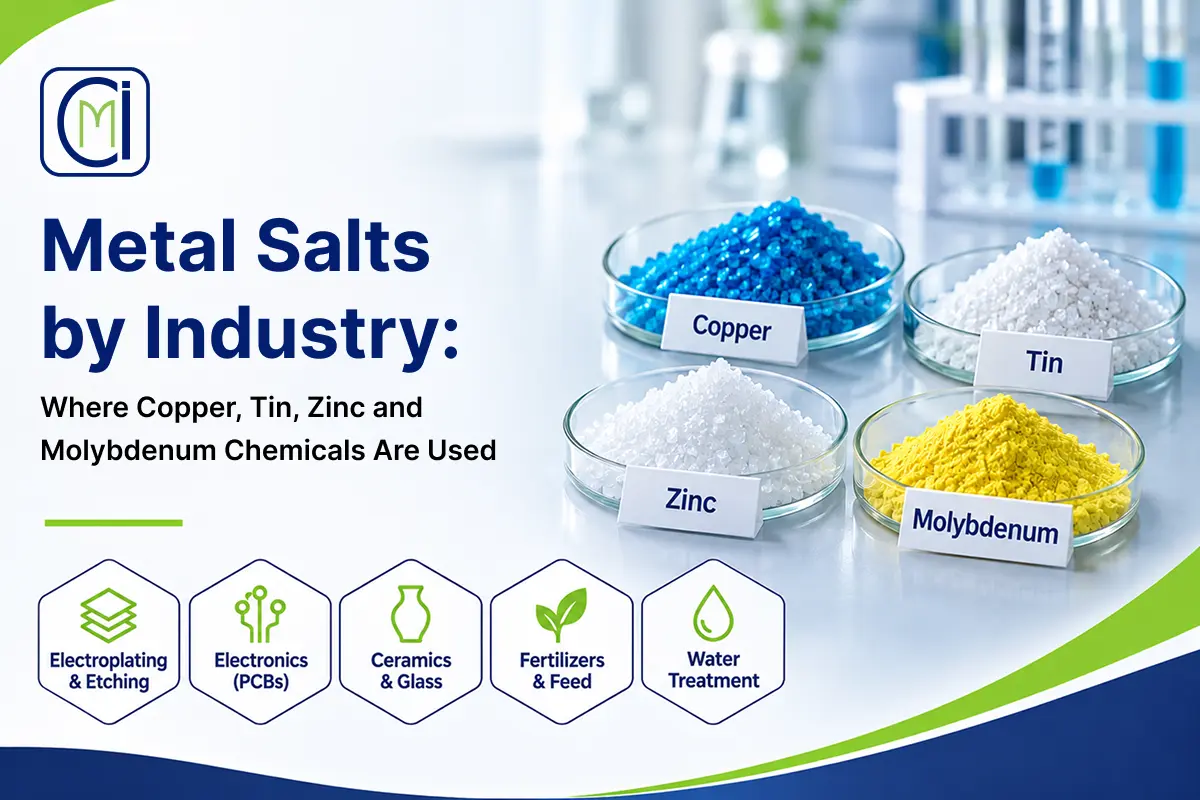
Metal salts in industry supply metal ions for plating and etching, act as catalysts, reducing agents and fluxes, colour ceramics, glass and pigments, provide trace nutrients for crops and feed, and inhibit corrosion in water systems. Copper, tin, zinc and molybdenum compounds cover most of these uses, from tin plating and PCB etching to galvanizing, ceramics and fertilizers. This guide maps each industry to the compound that serves it and shows what to check before you buy.
What Counts as a Metal Salt
A metal salt pairs a metal ion with an anion such as chloride, sulphate, stannate or molybdate. Related compounds, such as copper oxide and basic copper carbonate, are traded alongside them. The anion matters as much as the metal: chloride suits etching and many catalysts, sulphate suits acid plating baths, and oxides and carbonates are insoluble powders used where a chloride-free copper source is wanted, as in ceramics and electronics.
Metal Salts in Industry at a Glance
| Industry | Compounds | What they do |
|---|---|---|
| Tin plating and tinplate | Tin sulphate, tin chloride, sodium stannate, potassium stannate | Tin source for acid and alkaline plating baths on steel, copper and aluminium, including food-can steel. |
| Aluminium anodising | Tin sulphate | Main tin salt in electrolytic colouring baths for bronze, champagne and dark grey finishes. |
| PCBs and electronics | Cupric chloride dihydrate, tin sulphate, cupric oxide | Cupric chloride etches copper circuits, tin coats leads and connectors, and copper oxide serves semiconductor work. |
| Galvanizing and soldering | Zinc chloride, zinc chloride liquid | Flux before the molten zinc bath, and soldering flux for metalwork (too corrosive for electronics). |
| Ceramics and glass | Cupric oxide, basic copper carbonate | Colour glazes and glass: green in oxidation firing, red in reduction firing. |
| Pigments | Cuprous chloride, ammonium molybdate | Copper source (cuprous chloride) and catalyst (ammonium molybdate) in copper phthalocyanine pigment synthesis. |
| Textiles and dyeing | Tin chloride, sodium stannate, potassium stannate, zinc chloride | Dye mordant, silk weighting, peroxide bleaching stabiliser, cotton mercerising and durable-press finishes. |
| Catalysts, refining and synthesis | Cuprous chloride, anhydrous cupric chloride, ammonium molybdate, zinc chloride | Sandmeyer and Wacker reactions, oxychlorination, desulfurization catalysts and Lewis acid catalysis. |
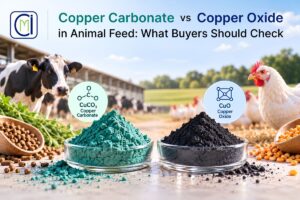
| Animal feed and fertilizers | Basic copper carbonate, cupric oxide, sodium molybdate, ammonium molybdate | Copper for feed premixes (compare copper carbonate vs copper oxide in animal feed) and molybdenum for micronutrient fertilizers, subject to local rules. |
| Water treatment | Sodium molybdate, zinc chloride liquid | Corrosion inhibitors for cooling and closed-loop systems. See water treatment chemicals in India. |
| Wood preservation | Basic copper carbonate, cupric oxide | Copper source in preservative formulations. |
| Batteries | Zinc chloride, cupric oxide | Electrolyte paste in heavy-duty zinc-carbon cells; copper oxide as an electrode material. |
| Activated carbon | Zinc chloride | Chemical activating agent for carbon made from wood and agricultural residues. |
| Flame retardants | Sodium stannate, potassium stannate | Tin source for halogen-free flame-retardant additives in plastics and textiles. |
| Molybdenum metallurgy and labs | Ammonium molybdate | Raw material for molybdenum trioxide and metal powder, and reagent for phosphate and silicate tests. |
Not sure which salt fits your process?
What to Check Before You Buy, by Industry
| Industry | Numbers that matter |
|---|---|
| Tin plating and anodising | Sn content, free acid (sulphate) or free alkali (stannates), chloride, insolubles |
| PCB etching | Copper content, iron, water-insoluble matter, anhydrous or dihydrate form |
| Galvanizing and soldering flux | ZnCl2 assay, iron, powder or liquid form |
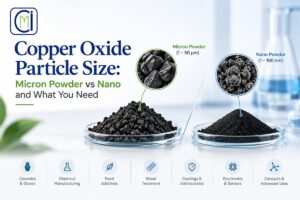
| Ceramics and glass | CuO or copper content, particle size, iron, chloride |
| Catalysts and synthesis | Purity, chloride, moisture, particle size |
| Feed and fertilizers | Metal content, contaminant data, limits in your market |
| Molybdenum uses | Mo content, solution pH, chloride, insolubles, iron |
| Every industry | Certificate of analysis for the batch and moisture-protective packing |
Compare Cost per Kilogram of Metal
Where two forms can do the same job, compare price per kilogram of metal, not per kilogram of powder. Ammonium molybdate carries about 54% molybdenum and sodium molybdate about 39%, so 1 kg of the ammonium salt supplies the molybdenum of roughly 1.4 kg of the sodium salt. Acid and alkaline plating baths are not interchangeable, so match the bath chemistry first and compare cost second.
The Meghachem Range by Metal
- Copper: cuprous chloride, cupric chloride anhydrous, cupric chloride dihydrate, basic copper carbonate and cupric oxide. Read copper oxide uses and copper carbonate uses, or browse all copper chemicals.
- Tin: tin chloride, tin sulphate, sodium stannate and potassium stannate, listed under tin chemicals.
- Zinc: zinc chloride and zinc chloride liquid. See zinc chloride liquid vs powder to pick a form, or browse zinc chemicals.
- Molybdenum: ammonium molybdate and sodium molybdate, listed under molybdate chemicals.
Handling and Transport
Several of these salts are corrosive or harmful to aquatic life, and the transport class can differ between the solid and liquid forms of the same salt. Use gloves and eye protection, store each product in a cool, dry place, and confirm classification against the safety data sheet and current regulations before shipping.
Sourcing Metal Salts From India
Meghachem manufactures these compounds in Vatva, Ahmedabad. The company is ISO 9001:2015 certified, serves 15+ industries in 20+ countries and sends a certificate of analysis with every shipment. Packs run from 25 and 50 kg bags and drums to bulk bags up to 1 MT, with IBC tanks for zinc chloride liquid and custom packing on request.
Meghachem manufactures copper, tin, zinc and molybdenum chemicals in Ahmedabad, ISO-certified and export-ready.
FAQs
What are metal salts used for in industry?
Plating and etching, catalysts and reducing agents, pigments and dyes, galvanizing and soldering flux, ceramics and glass, fertilizers and feed, and water treatment.
Which metal salts are used in electroplating?
Tin sulphate and tin chloride serve acid tin baths, while sodium and potassium stannate serve alkaline tin baths on steel, copper and aluminium.
What is zinc chloride used for?
Galvanizing and soldering flux, zinc-carbon dry cells, textile finishing, activated carbon production, wood treatment and Lewis acid catalysis in chemical synthesis.
What is sodium molybdate used for?
It is a corrosion inhibitor in cooling and closed-loop water systems and a molybdenum source in micronutrient fertilizers for molybdenum-deficient soils.
How do I choose between chloride, sulphate and oxide forms?
Match the anion to the process: chloride for etching and many catalysts, sulphate for acid plating baths, oxide or carbonate where a chloride-free copper source is needed. Then compare cost per kilogram of metal.