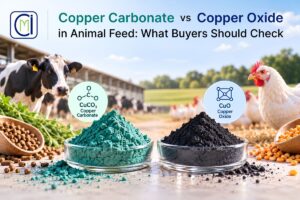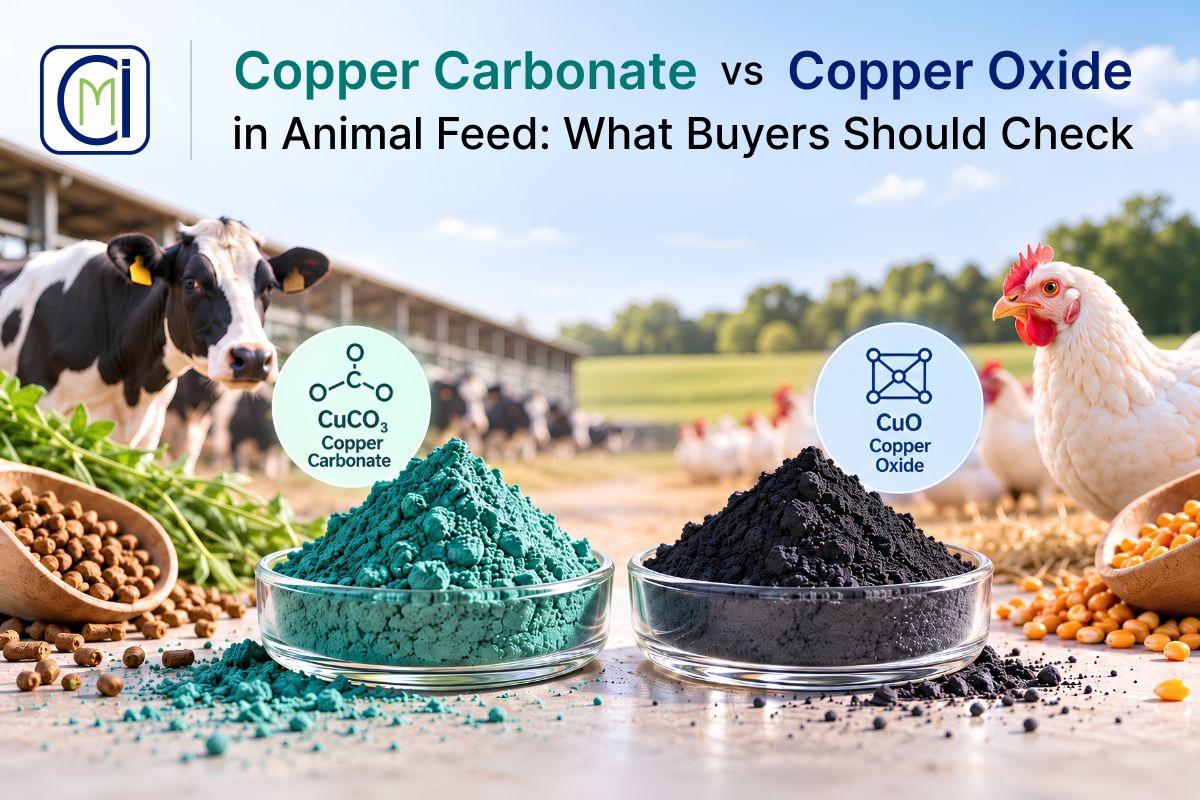
For copper carbonate vs copper oxide in animal feed, the short answer is that basic copper carbonate delivers far more usable copper per kilogram of product, even though copper oxide carries more copper per kilogram. In ruminant data, copper carbonate reached about 89% of copper sulphate on liver copper, while copper oxide is put at about 15%. Both are authorised EU feed additives, so the buyer’s questions are available copper per dollar, species limits and documents.
Copper Carbonate vs Copper Oxide at a Glance
| Copper carbonate | Copper oxide | |
|---|---|---|
| EU feed additive | Copper(II) carbonate dihydroxy monohydrate, 3b402 | Copper(II) oxide, 3b404 |
| Formula and CAS | CuCO3·Cu(OH)2·H2O, 100742-53-8 | CuO, 1317-38-0 |
| EU minimum copper | 52% | 77% |
| Ruminant bioavailability (sulphate = 100%) | About 89% | About 15% |
The bioavailability figures come from single studies: a 2025 beef steer trial for the carbonate (liver copper) and a Harper Adams University thesis for the oxide. They shift with species, diet and particle size, so use them for planning, not as guarantees.
What the Bioavailability Data Shows
Copper carbonate. In a 2025 Journal of Animal Science trial in beef steers, copper carbonate reached 89% of copper sulphate on liver copper, with plasma copper and ceruloplasmin tending higher. An earlier heifer study found it kept plasma copper up but was stored less efficiently in the liver. Overall it performs in the range of sulphate, usually a little below it on liver storage.
Copper oxide. In growing calves, copper oxide was essentially unavailable compared with copper sulphate and copper lysine. The Harper Adams thesis puts conventional copper oxide at about 0.15 of sulphate, and a University of Florida paper concludes it is not recommended but still widely used. For pigs and poultry, one nutrition commentary is titled “Cupric oxide should not be used as a copper supplement for either animals or humans”.
Where oxide still fits. Oral copper oxide needles kept range cattle in the normal blood copper range in Washington trials, even on high-molybdenum pasture. That is a targeted ruminant product, not a reason to use powder as the main source in a premix.
Do not mix up the oxides. Cuprous oxide (Cu2O, CAS 1317-39-1) has its own EU authorisation, 3b412, and has been studied as a feed source in broilers and pigs. Cupric oxide (CuO, CAS 1317-38-0) is a different material, so confirm which one a quote means.
Do the Cost Math on Available Copper
Compare price per kilogram of available copper, not per kilogram of powder: price ÷ (copper fraction × relative bioavailability). Using Meghachem’s minimum copper and the ruminant figures above:
| Copper carbonate | Copper oxide | |
|---|---|---|
| Copper (min) | 56.5% | 77.5% |
| Relative bioavailability | 0.89 | 0.15 |
| Sulphate-equivalent copper per kg | 0.50 kg | 0.12 kg |
One kilogram of carbonate supplies about 4.3 times the available copper of one kilogram of oxide, so the oxide would need to cost about 77% less per kilogram to break even. This is an illustration only. Recalculate with the bioavailability figure your nutritionist uses for your species.
EU Copper Limits by Species
The EU caps total copper from all sources in complete feed at 12% moisture. Both additives apply to all species, must be added through a premixture, and are authorised until 13 August 2028 under Implementing Regulation (EU) 2018/1039.
| Species or category | Maximum total copper, mg/kg |
|---|---|
| Calves before rumination, and sheep | 15 |
| Other cattle | 30 |
| Goats | 35 |
| Piglets up to 4 weeks after weaning | 150 |
| Piglets 5 to 8 weeks after weaning | 100 |
| Crustaceans | 50 |
| Other species | 25 |
Other markets set their own limits, so check the rules where the feed will be sold.
Sourcing copper for feed or premix?
What Buyers Should Check
| Check | What to look for |
|---|---|
| Identity | Name, formula and CAS on the quote and COA. CuO is 1317-38-0, Cu2O is 1317-39-1. |
| Copper content | A lot result at or above the authorisation minimum: 52% for carbonate, 77% for oxide. |
| Available copper | Bioavailability for your species, and price per kilogram of available copper. |
| Limits | Total copper from all sources against the species cap, especially for sheep and young calves. |
| Particle size | D50 and D90, so copper blends evenly into a premix at low inclusion. |
| Contaminants | Lead, arsenic, cadmium and mercury results on the COA. |
| Documents | Lot COA, SDS and any feed-safety certification your customers require, such as FAMI-QS or GMP+. |
| Diet antagonists | High molybdenum, sulphur or iron cuts copper availability for any source. Set the dose with a nutritionist. |
Meghachem Copper Carbonate and Copper Oxide at a Glance
- Basic copper carbonate: purity 98.50% min, copper 56.50% min, carbonate 26.00% min, chloride not detected, iron 100 ppm max
- Cupric oxide: CuO 97.00% min, copper 77.50% min, chloride not detected, iron 50 ppm max
- Acid insoluble 100 ppm max for both, in lined HDPE bags of 25 and 50 kg, with bulk bags up to 1 MT
- Custom particle size and packing on request, with a certificate of analysis on every shipment
- Part of the copper chemicals range, exported to 25+ countries
Feed use adds documents and test data beyond the general grade, so ask what is available for your market before you order.
Meghachem manufactures basic copper carbonate and cupric oxide in Ahmedabad, ISO-certified and export-ready.
FAQs
Which is better for animal feed, copper carbonate or copper oxide?
On available copper, copper carbonate: about 89% of sulphate in ruminant data, against about 15% for copper oxide. Oxide carries more copper per kilogram, but little of it is absorbed.
Is copper oxide allowed in animal feed?
In the EU, copper(II) oxide (3b404) and copper(II) carbonate dihydroxy monohydrate (3b402) are both authorised for all species until 13 August 2028, subject to species limits. Check your own market.
What is the maximum copper allowed in feed?
In the EU, total copper is capped at 15 mg/kg for sheep and calves before rumination, 30 for other cattle, 35 for goats and 25 for most other species.
Is cuprous oxide the same as copper oxide in feed?
No. Cuprous oxide (Cu2O, CAS 1317-39-1) has its own EU authorisation, 3b412, and differs from cupric oxide (CuO, CAS 1317-38-0). Confirm which one you are quoted.
What should I ask a copper supplier for feed use?
The name and CAS number, a lot COA with copper content and heavy-metal results, particle size, the safety data sheet and any feed-safety certification your customers require.