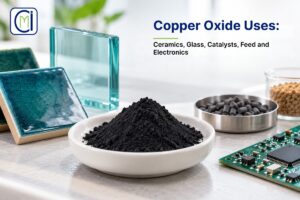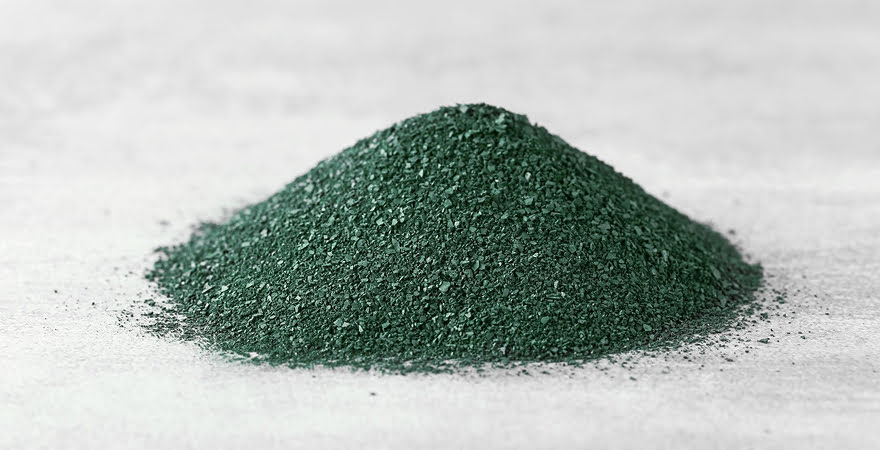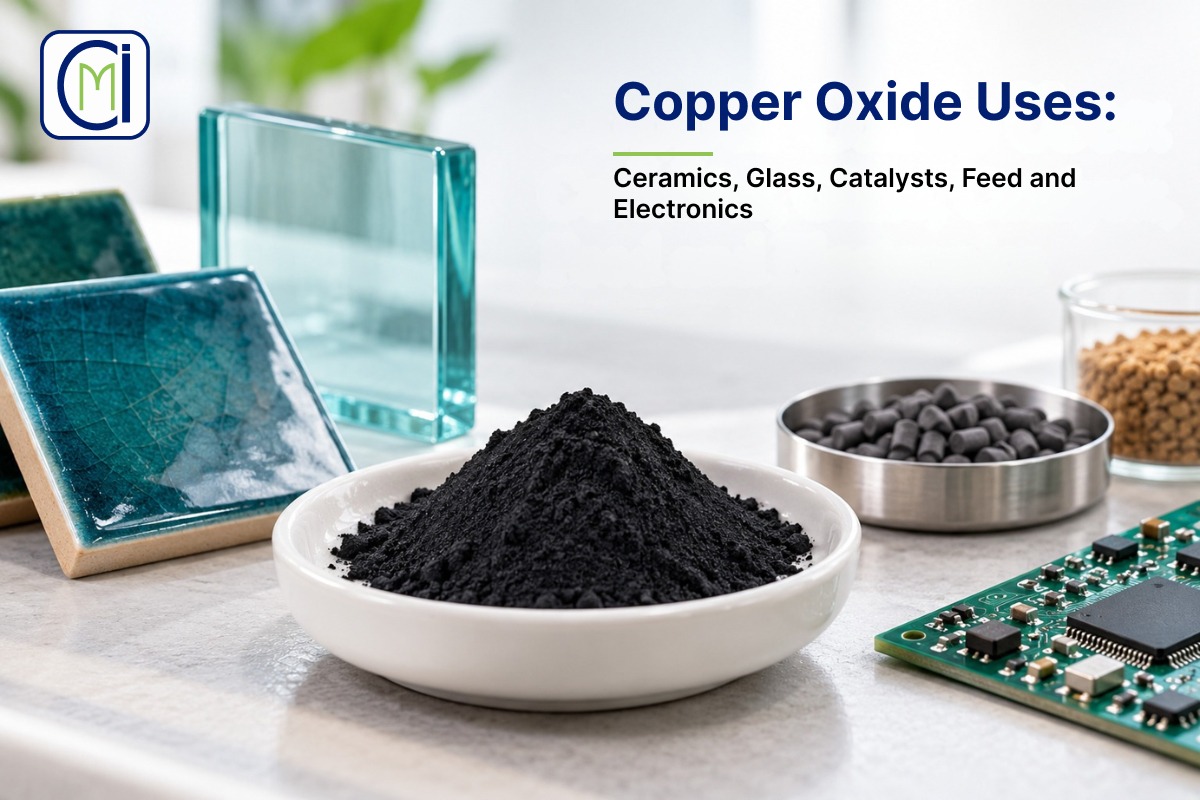
The main copper oxide uses are colouring ceramics and glass, catalysis, copper supplementation in feed and fertilizer, wood preservatives, making copper salts, and semiconductor and battery materials. Most of them rely on cupric oxide (CuO), a black, water-insoluble powder with about 80% copper. This guide covers each use, what to specify for it, and what to check before you buy.
What Is Copper Oxide?
Two oxides share the name. Cupric oxide (CuO) is black and carries about 79.9% copper. Cuprous oxide (Cu2O) is red and carries about 88.8%. This guide covers CuO, which does not dissolve in water but dissolves in mineral acids to form copper(II) salts. It is also what basic copper carbonate becomes when heated, losing about 28% of its weight as carbon dioxide and water.
Copper Oxide Uses
1. Ceramics and Glazes
This is the main colour use. In oxidation firing, copper oxide stays CuO and gives green. Alkaline or boron-rich glazes push it towards blue, and tin or zircon in alkaline, low-alumina glazes give turquoise or blue-green. In reduction firing it converts to Cu2O or colloidal copper and gives red, often from about 0.5% copper. Two cautions: copper is a strong flux, so 2% can make a stable glaze run, and it can raise lead solubility, so test any glaze meant for food contact. Swapping from copper carbonate? About 3.6% black oxide replaces 5% carbonate.
2. Glass, Porcelain and Gems
Copper oxide colours glass, porcelain and artificial gems. Oxidised melts give blue-green tones, while copper ruby red needs reducing conditions, where Cu2O or colloidal copper forms. Copper oxide is also listed as a polish for optical glass.
3. Catalysts
Supplier literature lists CuO as a catalyst for oxidation and organic synthesis and for removing sulfur from oils. In methanol synthesis and low-temperature water-gas shift, copper metal does the work, but it starts as an oxide: commercial Cu/ZnO/Al2O3 catalysts are co-precipitated, calcined to an oxide mixture and reduced in place. Chloride can poison copper catalysts, so a chloride-free grade is the usual request.
4. Animal Feed and Fertilizer
Copper is an essential trace mineral, and EU Regulation 2018/1039 authorised copper(II) oxide as a feed additive, with limits that vary by species. Check the current rules for your market. Know the trade-off: CuO dissolves slowly. In a calf study it was essentially unavailable compared with copper sulfate and copper lysine, and a University of Florida paper does not recommend it as a copper source for livestock. Oral copper oxide needles are a different case: in Washington trials they kept range cattle in the normal blood copper range. Agree the source with your nutritionist. CuO is also supplied as a copper micronutrient for fertilizers.
5. Electronics and Batteries
CuO is a p-type semiconductor with a narrow band gap, reported at about 1.2 to 1.4 eV. It is studied as a solar-cell absorber layer and in photodetectors and gas sensors, and it is a building block of superconducting cuprates. In batteries, a copper oxide electrode was part of the Edison-Lalande cell, and one lithium cell type (IEC code G) has used it. Much of this work is at research or specialty scale, so state purity and particle size when you enquire.
6. Copper Salts, Wood Treatment and Other Uses
- Copper salts: CuO dissolves in acids, so it is a starting material for copper sulphate, cupric chloride and other salts.
- Wood treatment: micronized copper preservatives use copper oxide or basic copper carbonate, milled to sub-micron particles.
- Process uses: welding flux for bronze, rayon production and electroplating appear in supplier literature.
- Paints and crops: antifouling paints and fungicides mostly use cuprous oxide (Cu2O), not CuO.
Need copper oxide for ceramics, catalysts or feed? Request specifications and pricing from Meghachem →
What to Specify for Each Use
| Use | Numbers that matter |
|---|---|
| Ceramics and glass | CuO and copper %, particle size, iron |
| Catalysts | Purity, chloride, particle size, surface area |
| Feed and fertilizer | Copper %, contaminant data, limits in your market |
| Electronics and batteries | Purity, chloride, iron, micron or nano size |
| Copper salts and wood treatment | Copper %, acid insolubles, fineness |
Meghachem Copper Oxide at a Glance
- CuO 97.00% min, copper 77.50% min, CAS 1317-38-0
- Chloride not detected, acid insoluble 100 ppm max, iron 50 ppm max
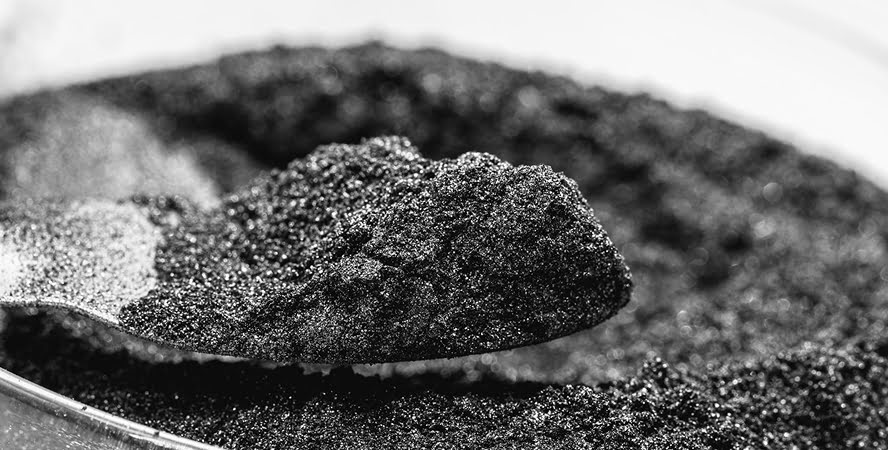
- Fine black powder in lined HDPE bags of 25 and 50 kg, bulk bags up to 1 MT
- Custom particle size, purity and packing on request
- Certificate of analysis with every shipment, part of the copper chemicals range, exported to 25+ countries
Handling and Transport
Use gloves and dust protection, keep copper oxide dry, and follow the safety data sheet. Many SDSs list it as UN 3077 (Class 9, marine pollutant), but classifications vary by supplier, so confirm yours against the SDS and the current IMDG Code before shipping.
Meghachem manufactures copper oxide in Ahmedabad, ISO-certified and export-ready. Talk to our team about your application →
FAQs
What is copper oxide used for?
Colouring ceramics and glass, catalysts, copper supplementation in feed and fertilizer, wood preservatives, making copper salts, and semiconductor and battery materials.
What is the difference between CuO and Cu2O?
CuO (cupric oxide) is black with about 79.9% copper. Cu2O (cuprous oxide) is red with about 88.8% copper and is the usual choice for antifouling paint, fungicides and red glass.
What colour does copper oxide give ceramics and glass?
Green in oxidation firing, moving towards blue or turquoise in alkaline or boron-rich glazes. Red needs reduction firing, where copper forms Cu2O or colloidal copper.
Is copper oxide good for animal feed?
EU Regulation 2018/1039 authorised it as a feed additive, but CuO is poorly absorbed by cattle compared with copper sulfate. Agree the source with your nutritionist and check local rules.
What specification does Meghachem copper oxide meet?
CuO 97.00% min, copper 77.50% min, chloride not detected, acid insoluble 100 ppm max and iron 50 ppm max. Custom particle size on request, with a COA on every shipment.