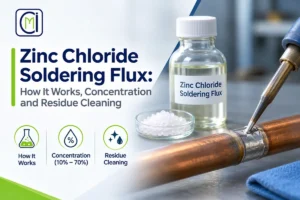
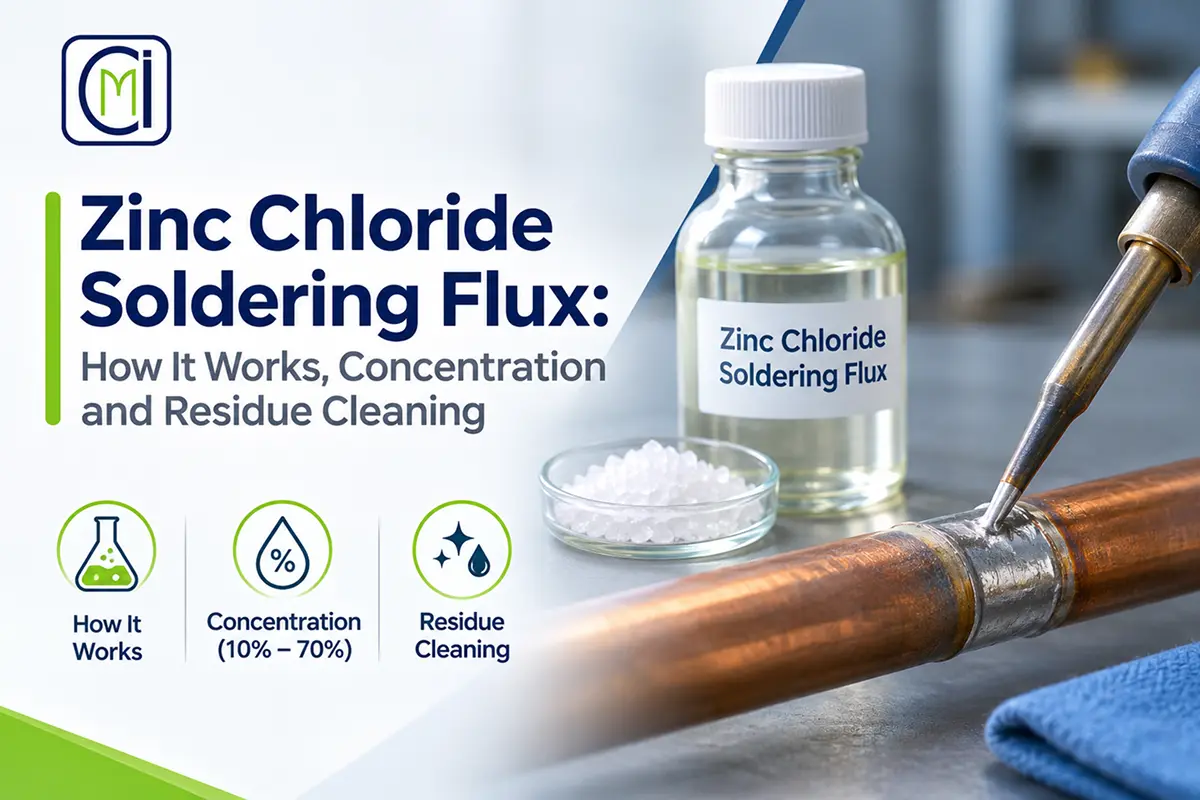
Zinc chloride soldering flux is an acid flux. When heated, it releases hydrochloric acid that dissolves the oxide film on steel, copper and brass, so molten solder can wet the metal. Safety data sheets for commercial fluxes list 10 to 70% zinc chloride, and the residue is corrosive, so it must be washed off. This guide covers how the flux works, what strength to use, how to mix it from zinc chloride powder or liquid, and how to clean up.
How Zinc Chloride Soldering Flux Works
Every metal surface carries an oxide film that molten solder will not wet, and heating grows it faster. The flux deals with this in three steps:
- It melts and releases acid. Zinc chloride reacts with moisture at soldering temperature to form hydrochloric acid and an oxychloride. Ammonium chloride, if present, breaks down into ammonia and hydrochloric acid.
- The acid dissolves the oxide. Metal oxide plus acid gives a salt plus water, leaving clean metal.
- The liquid film protects the joint. It keeps air off the clean metal and lowers the surface tension of the solder, which then spreads into the joint and displaces the flux.
The same chemistry explains the downside. Zinc chloride is very hygroscopic, non-volatile and corrosive when moist, so any flux the solder does not displace stays on the work and keeps attacking the metal.
Where It Works and Where It Does Not
| Use | Fit |
|---|---|
| Steel, stainless steel and nickel | The most common uses |
| Copper, brass and galvanized iron | Suitable, with the residue washed off |
| Aluminium and magnesium | Not suitable |
| Electronics and electrical connections | Do not use. The residue is corrosive, so rosin flux is used instead |
| Joints where residue cannot be cleaned out | Avoid. Leftover flux corrodes the metal later |
Zinc Chloride Flux Concentration
There is no single standard strength. Safety data sheets for four commercial fluxes show how wide the range is (weight percent, with free hydrochloric acid shown as HCl):
| Flux type | Zinc chloride | Ammonium chloride | Free HCl |
|---|---|---|---|
| Copper pipe paste | 10 to 30% | 1 to 5% | Not listed |
| General metalwork paste | 25 to under 50% | 10 to under 20% | Not listed |
| General purpose liquid | 30 to 45% | 4 to 15% | 3 to 10% |
| High-strength liquid | 40 to 70% | 5 to 10% | 5 to 10% |
Treat these as a range, not a target. A stronger flux clears heavy oxide faster but leaves more corrosive salt behind, so begin at the low end for your metal and raise the strength only if the solder will not wet. Apply a thin, even coat with a brush: excess flux is what leaves the residue.
Making Flux From Zinc Chloride Powder or Liquid
The traditional flux, known as killed spirits or killed acid, is made by dissolving zinc in hydrochloric (muriatic) acid until the bubbling stops, then diluting with water. The reaction releases hydrogen, so it needs ventilation and no flames. Dissolving ready-made zinc chloride gives a solution of known strength without that step.
To make 100 kg of flux solution, multiply the strength you want by 100 kg, divide by the assay of your product, and top up to 100 kg with water:
| Product | 30% flux | 40% flux |
|---|---|---|
| Anhydrous powder (98% assay) | 30.6 kg | 40.8 kg |
| Technical powder (90% assay) | 33.3 kg | 44.4 kg |
| Liquid (44% ZnCl2) | 68.2 kg | 90.9 kg |
Use the assay on your COA, add powder to the water in portions while stirring, and confirm the finished strength with a hydrometer. Liquid cannot make a flux stronger than its own 42 to 46%, so stronger fluxes need powder.
Blending your own flux?
How to Clean Zinc Chloride Flux Residue
Clean the work as soon as it has cooled. Zinc chloride residue holds moisture and corrodes the metal. On copper it shows up as green corrosion, and in extreme cases it can perforate the wall of a tube.
- Let the work cool naturally. Do not quench it in water, which can stress the joint.
- Wipe off the residue with a wet rag or damp sponge, or wash the work with soap and water.
- Rinse thoroughly with clean water. A poor clean can release trapped activators and make corrosion worse.
- Dry the work completely.
- Flush closed systems, such as pipework, where the end use allows.
- Collect heavy rinse water and dispose of it under local rules, because zinc chloride flux is toxic to aquatic life.
Safety and Storage
- The flux is corrosive and can burn skin and eyes. Wear gloves and eye protection, and apply it with a brush, not your fingers.
- Soldering gives off fumes. Work with ventilation or extraction and do not breathe them.
- Store solutions in HDPE, PP or fibreglass containers, not steel. Keep powder sealed and dry, because it absorbs moisture from the air.
- Neutralise spills with soda ash or sodium bicarbonate and keep them out of drains. Shipping zinc chloride? See GHS labelling for Indian exporters.
Zinc Chloride for Flux From Meghachem
Meghachem Industries makes zinc chloride powder and liquid at its Ahmedabad facility, with a COA on every shipment. Zinc chloride powder comes in Anhydrous (98 to 99%), Technical (90 to 92%) and Commercial (80 to 85%) grades. Zinc chloride liquid ships at 42 to 46% ZnCl2, with custom concentrations on request. Lower grades have a lower assay, so check the specification and COA to see what makes up the balance.
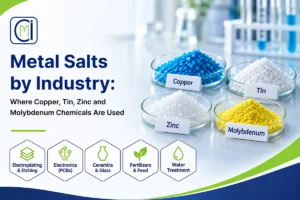
Not sure which form to buy? Read zinc chloride liquid vs powder, or browse zinc chemicals. Zinc chloride also serves galvanizing, batteries and textiles: see metal salts in industry.
Ready to order zinc chloride for flux?
FAQs
What is zinc chloride soldering flux used for?
It removes oxide so solder wets steel, stainless steel, nickel, copper, brass and galvanized iron. It is not for aluminium, magnesium or electronics.
How much zinc chloride is in soldering flux?
Safety data sheets for commercial fluxes list 10 to 70%, often with ammonium chloride added. Start at the low end and raise strength only if solder will not wet.
Can I use zinc chloride flux on electronics?
No. Suppliers do not recommend it for electrical or electronic work because the residue is corrosive. Use rosin-based flux instead.
How do I clean zinc chloride flux residue?
Let the work cool, wipe it with a wet rag or wash it with soap and water, rinse thoroughly with clean water and dry it. Do not quench a hot joint.
What is killed spirits flux?
It is the traditional flux made by dissolving zinc in hydrochloric acid until bubbling stops, then diluting with water. Dissolving ready-made zinc chloride avoids the hydrogen release.