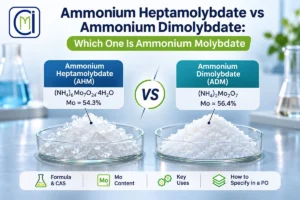
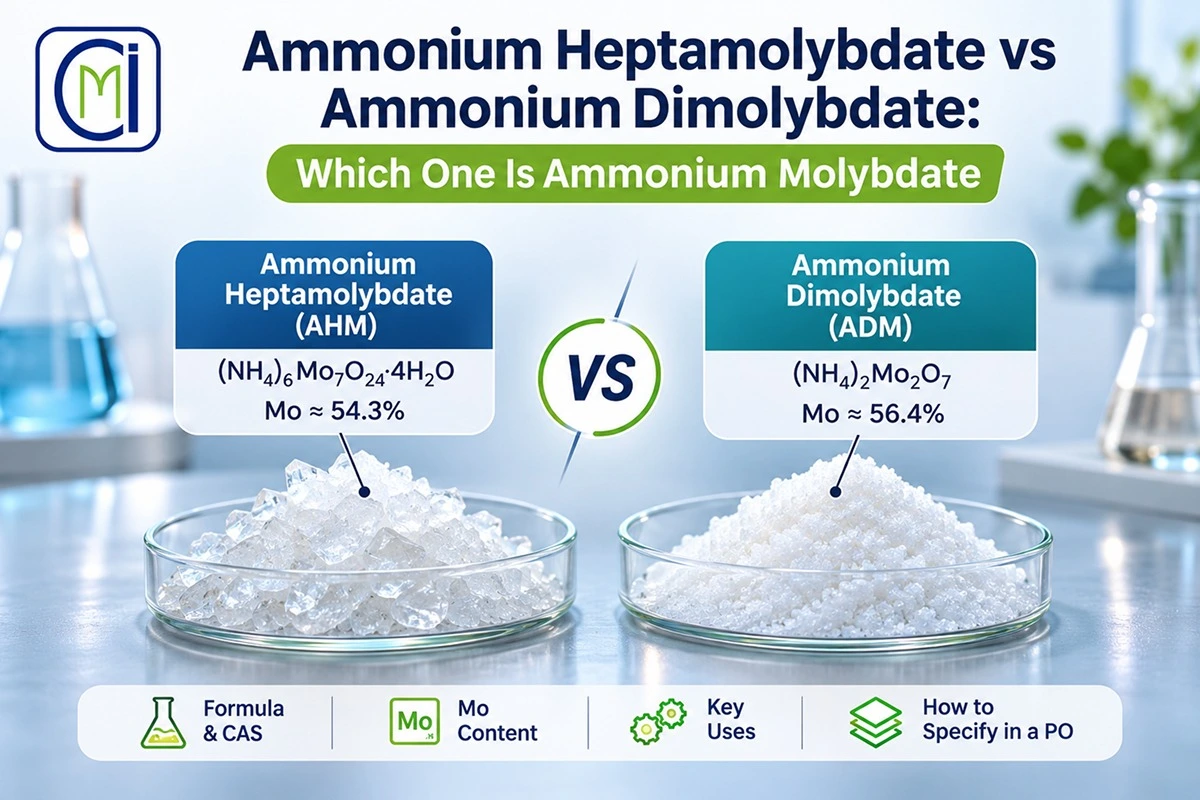
Ammonium heptamolybdate vs ammonium dimolybdate comes down to what a supplier means by “ammonium molybdate”. In catalogues the name usually points to ammonium heptamolybdate (AHM), (NH4)6Mo7O24·4H2O, with about 54% molybdenum. Ammonium dimolybdate (ADM), (NH4)2Mo2O7, is a different salt with about 56% molybdenum.
Quotes, certificates and purchase orders often use the loose name, so two suppliers can quote “ammonium molybdate” and ship different compounds. This guide compares the two salts by formula, CAS number and Mo content, then gives the wording that keeps a purchase order unambiguous.
Ammonium Heptamolybdate vs Ammonium Dimolybdate at a Glance
| Feature | Ammonium heptamolybdate (AHM) | Ammonium dimolybdate (ADM) |
|---|---|---|
| Formula | (NH4)6Mo7O24·4H2O (tetrahydrate) | (NH4)2Mo2O7 |
| CAS number | 12054-85-2 (anhydrous: 12027-67-7) | 27546-07-2 |
| Mo content (calculated) | 54.3% | 56.4% |
| MoO3 equivalent | 81.5% | 84.7% |
| Salt needed per kg of Mo | 1.84 kg | 1.77 kg |
| Appearance | Colourless to white crystals | White, free-flowing crystalline solid |
| Water solubility | Freely soluble | Freely soluble |
| Other names | Ammonium paramolybdate, often just “ammonium molybdate” | Ammonium molybdate (di), molybdic acid 85%, ammonium polymolybdate |
Mo and MoO3 figures are calculated from atomic masses. Supplier labels round differently, for example one supplier lists ADM as Mo 56.5%.
Which One Is Ammonium Molybdate?
There is no single answer, because the name covers three compounds:
- Ammonium heptamolybdate tetrahydrate is the usual meaning. Reagent catalogues list “ammonium molybdate” as a synonym for it, and it is also sold as ammonium paramolybdate.
- Ammonium dimolybdate appears as “ammonium molybdate (di)” on some supplier listings, and also as molybdic acid 85% or ammonium polymolybdate.
- Ammonium orthomolybdate, (NH4)2MoO4 (CAS 13106-76-8), is a third compound with about 49% Mo. Its solutions lose ammonia on heating and give ammonium heptamolybdate.
So the name alone settles nothing. The formula, CAS number and Mo content do.
Ammonium Heptamolybdate (AHM): The Usual Commercial Salt
AHM forms colourless crystals that dissolve freely in water, giving a mildly acidic solution (pH about 5.3 at 50 g/L and 20°C). Producers make it by dissolving molybdenum trioxide in aqueous ammonia and crystallising the salt as the solution cools.
Its main uses are a raw material for catalysts, molybdenum trioxide and metal powder, an analytical reagent for phosphate and silicate tests, and an ingredient in pigments and micronutrient fertilisers. Pigment makers use it too: see how ammonium molybdate works as a pigment catalyst in copper phthalocyanine synthesis.
Ammonium Dimolybdate (ADM): The Higher-Molybdenum Salt
ADM is a white, free-flowing crystalline solid that is also freely soluble in water. It crystallises from a hot solution as water and ammonia are driven off, while AHM crystallises as its solution cools. Its edge is concentration: about 4% more molybdenum per kilogram than AHM.
Supplier listings give ADM much the same end uses as AHM: catalyst production, molybdenum metal and trioxide, pigments, corrosion inhibitors and trace-element fertiliser. Datasheets also list impurity caps, for example iron and copper at 0.0015% maximum each in one producer’s grade, so ask for the limits that matter in your process.
How to Choose Between AHM and ADM
Both salts dissolve freely, so solubility rarely decides it. These checks usually do:
- The process says “ammonium molybdate”. A catalyst dose, fertiliser recipe or reagent method written that way was most likely written for AHM. Keep buying AHM, or get the process owner to approve a switch in writing.
- Contained molybdenum is what you pay for. ADM gives about 4% more Mo per kilogram, so compare quotes per kilogram of Mo, not per kilogram of salt.
- Phosphate or silicate testing. AHM is the standard reagent salt, so keep to it.
- The document shows (NH4)2MoO4. Confirm which salt is intended before ordering, because orthomolybdate carries only about 49% Mo.
Whichever you pick, a change of salt changes the molybdenum per kilogram, so recalculate the dose on contained Mo, not on weight of salt.
What to Write on a Molybdate Purchase Order
A vague name is one of the chemical supplier red flags buyers should catch early. For these salts, specify:
- Full name with hydration: ammonium heptamolybdate tetrahydrate or ammonium dimolybdate, alongside the trade name if you use one.
- Formula and CAS number: 12054-85-2 for AHM tetrahydrate (anhydrous AHM is 12027-67-7) and 27546-07-2 for ADM.
- Mo content, with the test method: compare it with theory, about 54% for AHM and 56% for ADM. A figure near 49% points to orthomolybdate.
- Other limits: solution pH, chloride, insolubles and iron, plus any trace metals your process cares about.
- A certificate of analysis for every lot, the grade (reagent or technical) and the pack size.
Not sure which molybdenum salt your process calls for?
Cost: Compare on Contained Molybdenum
Divide each quote by the Mo fraction of the salt. One kilogram of molybdenum needs 1.84 kg of AHM or 1.77 kg of ADM, so an AHM quote beats an ADM quote only if it is more than about 3.7% lower per kilogram.
If you only need soluble molybdenum, sodium molybdate is the other common option. One kilogram of ammonium molybdate supplies the molybdenum of roughly 1.4 kg of sodium molybdate dihydrate, but match the process chemistry first and compare cost second.
Ammonium Molybdate From Meghachem
Meghachem Industries manufactures ammonium molybdate and sodium molybdate in Vatva, Ahmedabad, listed under molybdate chemicals. Its ammonium molybdate is specified at about 54% Mo, which matches AHM, and every shipment goes with a certificate of analysis.
Molybdenum salts also serve pigments, catalysts, fertilisers and water treatment. For where else copper, tin, zinc and molybdenum chemicals are used, see metal salts in industry.
Need ammonium molybdate for catalyst, pigment or fertiliser use?
FAQs
Is ammonium molybdate the same as ammonium heptamolybdate?
Usually. Catalogues list ammonium molybdate as a synonym of ammonium heptamolybdate tetrahydrate (CAS 12054-85-2), but the name is also used for ammonium dimolybdate and orthomolybdate. Confirm by formula, CAS number and Mo%.
What is the difference between AHM and ADM?
They are different salts. AHM is (NH4)6Mo7O24·4H2O (CAS 12054-85-2) with about 54% Mo. ADM is (NH4)2Mo2O7 (CAS 27546-07-2) with about 56% Mo.
Which has more molybdenum, AHM or ADM?
ADM. It has about 56.4% Mo against 54.3% for AHM (calculated), roughly 4% more per kilogram. Compare quotes on price per kilogram of contained Mo.
What is ammonium dimolybdate used for?
Supplier listings cite catalyst production, molybdenum metal and trioxide, pigments, corrosion inhibitors and trace-element fertiliser, much the same as AHM.
What should a purchase order say for ammonium molybdate?
Give the full name with hydration, formula, CAS number, a Mo% limit with test method, other limits and a certificate of analysis for each lot.