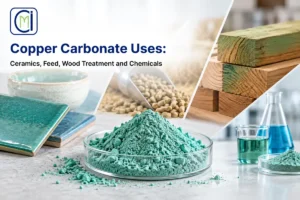
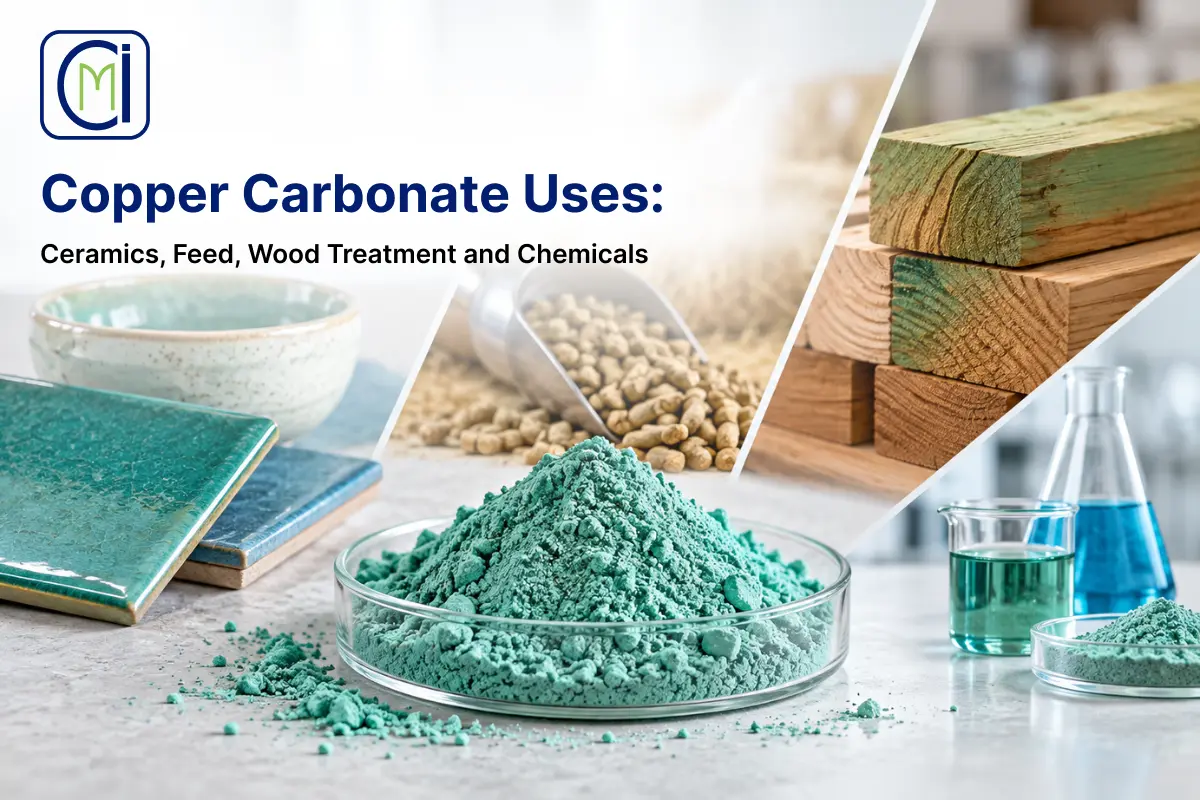
Copper carbonate is used mainly as a blue and green colourant in ceramics and glass, a copper source in animal feed, an ingredient in wood preservatives, and a starting material for copper salts and catalysts. The material sold under this name is basic copper carbonate, CuCO3·Cu(OH)2, which carries about 57% copper and dissolves in acids. This guide covers each use, what to specify for it, and where rules or defects catch buyers out.
What Is Copper Carbonate?
Strictly, neutral copper(II) carbonate (CuCO3) is not what suppliers sell. It does not occur naturally, and the green mineral malachite is basic copper carbonate. In trade, “copper carbonate” means basic copper carbonate. It is a pale green to blue-green powder that does not dissolve in water. It dissolves in acid to give a copper salt and carbon dioxide, and breaks down on heating to copper oxide and carbon dioxide, along with water, at around 300°C.
Copper Carbonate Uses
1) Ceramics and Glass Colour
This is the most familiar use. Copper carbonate gives blue and green tones in glazes, frits and glass, and potters’ references call it the most commonly used copper form in glazes. It spreads evenly because it is chemically reactive, but it releases carbon dioxide and water as it decomposes, which can leave pinholes or blisters if the gas is trapped. With about 57% copper against 80% in copper oxide, roughly 5% copper carbonate does the work of 3.6% copper oxide. Specify copper content, a fine particle size, and low iron and chloride.
2) Animal Feed
Copper carbonate is used as an animal feed additive, supplying copper as a micronutrient in feed and premixes. Rules are market specific. In the EU, for example, copper(II) carbonate dihydroxy monohydrate is an authorised feed additive for all animal species, specified as a powder with a minimum of 52% copper. Check that a supplier’s grade, copper content and documents match the rule in your own market before ordering.
3) Wood Treatment
Micronized copper preservatives such as MCA and MCQ use sparingly soluble copper compounds, such as basic copper carbonate, milled to sub-micron particles and dispersed in water rather than dissolved. Copper oxide is also used. Reported particle sizes run from about 1 to 700 nm, averaging under 300 nm, because larger particles do not penetrate wood cell walls adequately. Wood treated this way is less corrosive to metal fasteners and lighter in colour than wood treated with conventional dissolved-copper systems. As the powder is milled further, its purity and starting particle size matter.
4) Copper Salts, Catalysts and Gas Purification
Because it dissolves cleanly in acid, copper carbonate is a convenient starting point for copper sulphate, cupric chloride, nitrate and other salts. It is also a precursor to catalysts and copper soaps, and has been used to remove thiols and hydrogen sulfide from gas streams. It is also used as a petroleum sweetening agent. Here the numbers that matter are copper content and acid-insoluble matter.
5) Plating, Electronics and Other Uses
- Plating: an additive in copper plating systems and in copper-tin alloy plating.
- Electronics: a high-purity copper source for depositing copper oxide layers in semiconductor work.
- Agriculture: historically a seed-treatment fungicide and smut preventive, and an algaecide. Pesticide use is regulated, so confirm registration before any agricultural formulation.
- Pigments and fireworks: an artist pigment used since antiquity and a blue-green flame colourant.
Need copper carbonate for ceramics, feed or wood treatment?
What to Specify for Each Use
| Use | Numbers that matter |
|---|---|
| Ceramics and glass | Copper %, particle size, iron, chloride |
| Animal feed | Copper %, feed-grade documents, limits set by your market |
| Wood treatment | Purity, starting particle size |
| Salts and catalysts | Copper %, acid-insoluble matter |
| Electronics | Purity, chloride, iron |
Meghachem Copper Carbonate at a Glance
- Purity 98.50% min, copper 56.50% min, carbonate 26.00% min
- Chloride not detected, acid insoluble 100 ppm max, iron 100 ppm max
- Lined HDPE bags of 25 and 50 kg, bulk bags up to 1 MT
- Custom particle size, purity grades and packing on request
- Certificate of analysis with every shipment, exported to 25+ countries
Handling and Safety
Copper carbonate can irritate skin and is toxic if swallowed, because it dissolves in stomach acid to release copper ions. Use gloves and dust protection, keep it dry and away from acids and heat, and follow the safety data sheet. Many SDSs list UN 3077 (Class 9, marine pollutant) for transport, but classifications vary by supplier, so confirm yours before shipping.
Meghachem manufactures copper carbonate in Ahmedabad, ISO-certified and export-ready
FAQs
Mainly as a blue and green colourant in ceramics and glass, a copper source in animal feed, an ingredient in wood preservatives, and a starting material for copper salts and catalysts.
In trade, yes. Neutral CuCO3 is not what is sold. The basic form, CuCO3.Cu(OH)2, occurs naturally as malachite.
Yes, as a copper micronutrient. Rules vary by country. The EU, for example, authorises copper(II) carbonate dihydroxy monohydrate at a minimum of 52% copper, so check your market.
It can irritate skin and is toxic if swallowed. Handle it with gloves and dust protection, and follow the SDS.
Yes: purity 98.50% min, copper 56.50% min, chloride not detected, in 25 and 50 kg bags and bulk bags up to 1 MT, with a COA on every shipment.