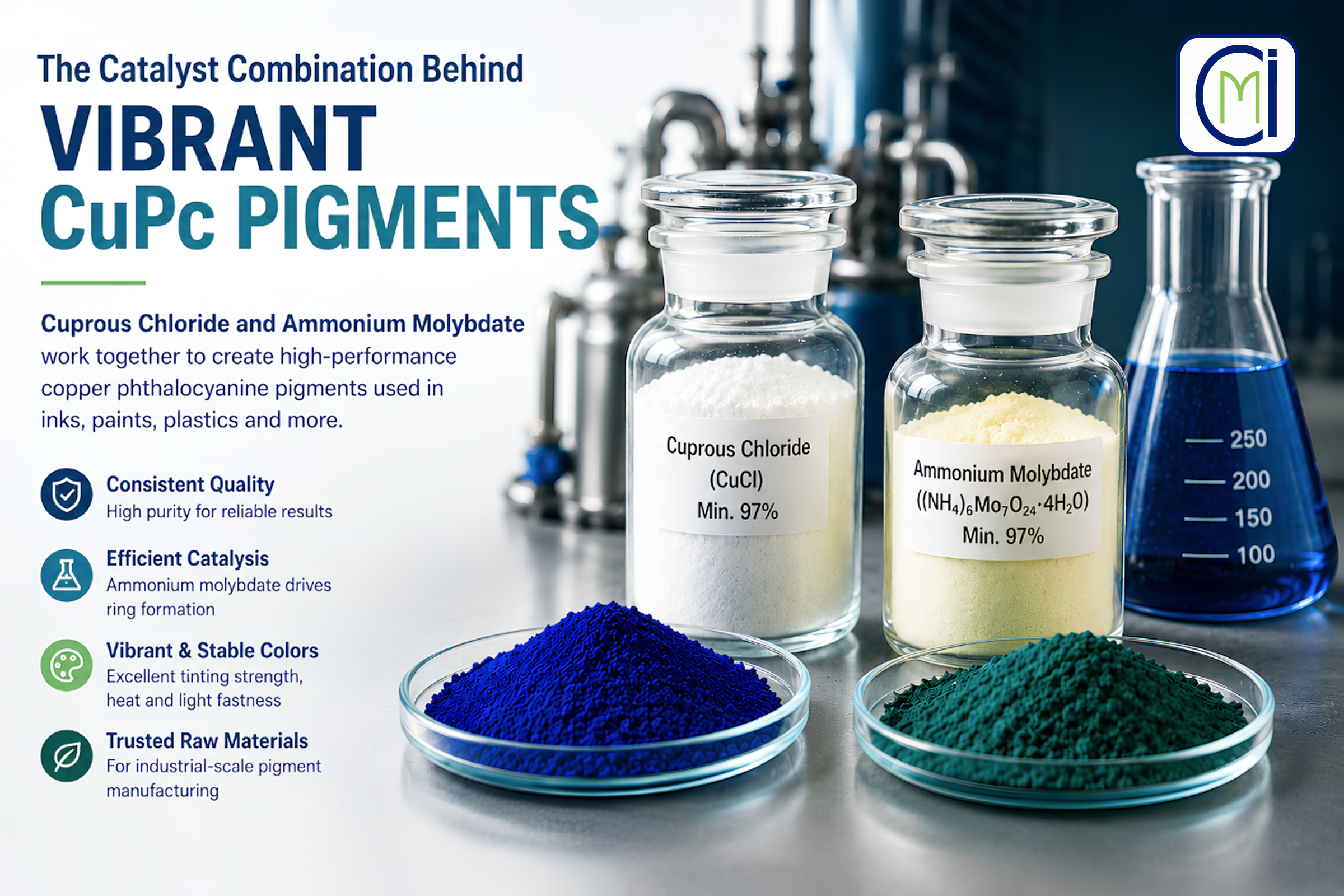
Most copper phthalocyanine (CuPc) pigment is made by heating phthalic anhydride, urea, a copper source, and a small amount of catalyst together in a solvent. Cuprous chloride usually supplies the copper. Ammonium molybdate drives the reaction that closes the phthalocyanine ring. Together, they turn a handful of inexpensive raw materials into the blue and green pigment used in inks, paints, and plastics worldwide.
This exact process shows up across dozens of chemical patents, but rarely anywhere in plain language. Here’s how the two chemicals actually work, and why the grade you buy changes the pigment you get.
What Is Copper Phthalocyanine (CuPc) Pigment?
Copper phthalocyanine is a synthetic pigment built around a single copper atom held inside a ring of linked nitrogen and carbon molecules. In its standard form it produces an intense blue; chlorinated versions shift toward green. Both are prized for a combination that’s hard to match: strong tinting power, resistance to heat, and resistance to fading or dissolving in solvents.
That’s why CuPc pigments turn up in printing inks, automotive paint, plastics, and textile dyes. None of that color forms on its own. It’s built from four raw materials and one catalyst.
How Copper Phthalocyanine Pigment Is Actually Made
Industrial CuPc production still runs largely on what’s called the urea process, sometimes referred to as the Wyler method. Cuprous chloride, urea, and phthalic anhydride (or phthalimide) are combined in a high-boiling solvent, commonly trichlorobenzene or an alkylbenzene, along with a small measured amount of ammonium molybdate as catalyst.
The batch is heated to roughly 180 to 200°C and held there for several hours. Under that heat, the copper atom locks into the center of four linked phthalocyanine units, forming crude CuPc.
That crude material isn’t pigment-ready yet. It goes through a second step called conditioning, where it’s either dissolved in acid and reprecipitated or milled down to a much finer particle size. Skip this step, and the same chemical looks dull instead of vivid: particle size, not just the underlying chemistry, is what gives CuPc its tinting strength.
Cuprous Chloride's Role: Supplying the Copper
The phthalocyanine ring needs a copper ion at its center, and that copper has to arrive in a form the reaction can use cleanly.
Cuprous chloride (copper(I) chloride, CuCl) is one of the most established choices for this. It dissolves predictably in the reaction mixture and, at higher purity, leaves very little unreacted copper behind. Copper metal, copper oxide, and basic copper sulfate can all substitute for it, but cuprous chloride remains common in industrial runs because of the control it gives over how much copper actually enters the reaction.
Purity matters more here than the raw materials list suggests. Lower-purity grades tend to leave more free copper in the finished batch, which shows up later as reduced color strength or a duller, less consistent shade.
Ammonium Molybdate's Role: Driving the Reaction
Left to react on their own, phthalic anhydride, urea, and a copper source combine too slowly and unevenly for commercial production. Ammonium molybdate fixes that. Used in a small fraction, often under 10 percent of the copper compound’s weight, it catalyzes the cyclization reaction that actually forms the phthalocyanine ring.
Ammonium molybdate isn’t the only catalyst that works here. Molybdenum trioxide, molybdic acid, and even titanium tetrachloride appear in patent literature for the same job. Ammonium molybdate stays a common default because it’s water-soluble, easy to dose accurately in small quantities, and carries no chloride or extra metal contaminants into the batch.
Sourcing cuprous chloride or ammonium molybdate for a CuPc production line?
Request current specifications and pricing from Meghachem
Why Purity and Grade Matter for Pigment Quality
Both inputs are used in small, precise amounts, so small swings in purity have an outsized effect on the finished pigment. Off-spec cuprous chloride leaves excess free copper behind, which reads as weaker tinting strength or an inconsistent shade batch to batch. Uneven ammonium molybdate dosing slows or stalls the cyclization step, pushing more crude material into rework during conditioning.
For pigment manufacturers, that makes supplier consistency almost as important as the chemistry itself. A batch that varies shipment to shipment forces constant recalibration on the plant floor. Buying from a supplier that holds tight purity specifications across every batch is often the simpler fix.
Meghachem Industries has manufactured cuprous chloride and cupric chloride for copper phthalocyanine pigment producers since 2002, alongside ammonium and sodium molybdate for the catalyst side of the same process.
FAQs
Phthalic anhydride (or phthalimide), urea, a copper source such as cuprous chloride, and a catalyst such as ammonium molybdate, heated together in an inert solvent.
Yes. Copper metal, copper oxide, and basic copper sulfate are also used, but cuprous chloride is common because of its solubility and consistent copper content.
No. Molybdenum trioxide, molybdic acid, and titanium tetrachloride are alternatives, but ammonium molybdate is widely used for its solubility and ease of dosing.
Industrial batches typically run between 180°C and 200°C, held for several hours to complete the reaction.
Most producers use 97 percent purity or higher for both inputs. Lower purity increases free-copper impurities and inconsistent color strength.